What Is a Smart Oral Device?
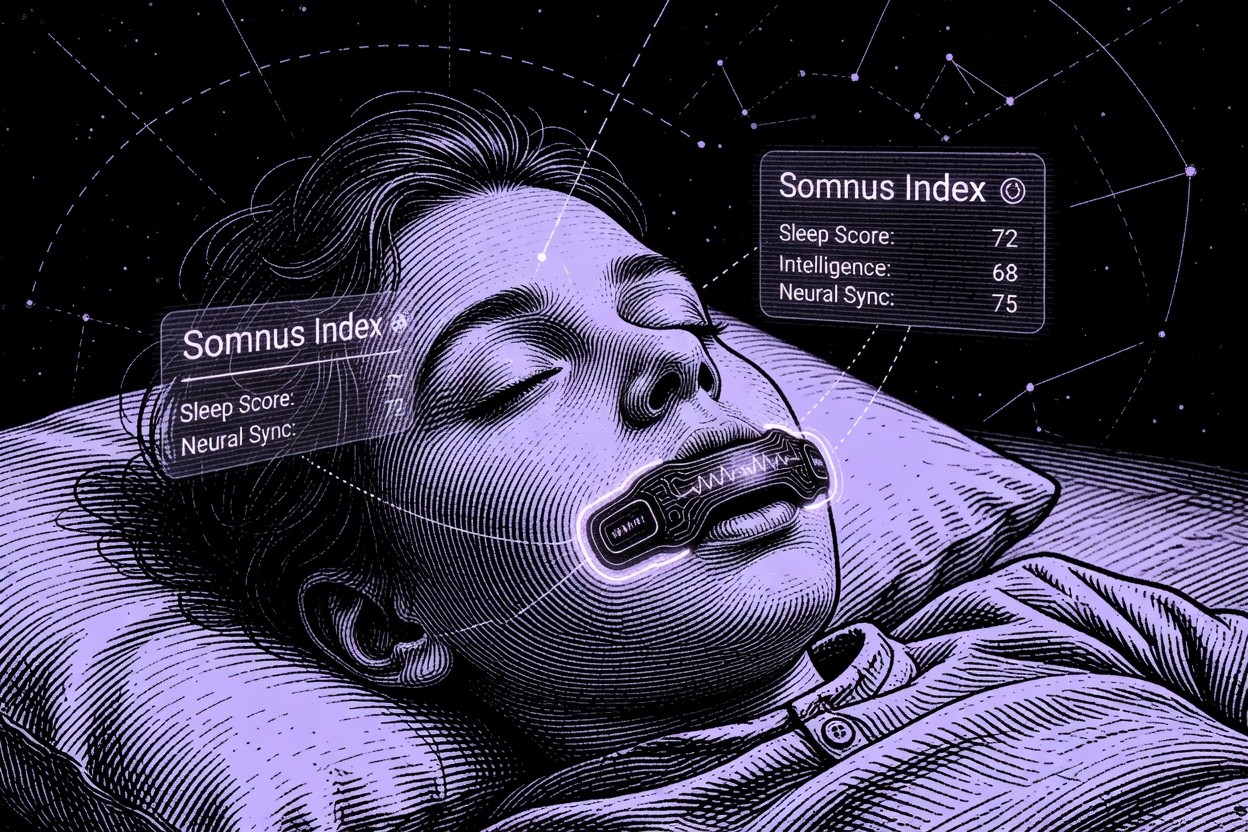
Oral appliance therapy has been a mainstream treatment for obstructive sleep apnea and snoring for decades. Millions of patients wear mandibular advancement devices each night to keep the airway open during sleep. Yet for most of that time, the devices have functioned as passive mechanical tools — they hold the jaw in a forward position and nothing more. They generate no data. They provide no feedback. They cannot tell a clinician how long they were worn, whether they actually worked, or when they stopped being effective.
That is changing. A new category of smart oral devices — integrating sensors, artificial intelligence, wireless data transmission, and app-based monitoring — is emerging to transform how sleep apnea and snoring are managed.
The Problem with Traditional Oral Appliances
The limitations of conventional oral appliances are well-documented among sleep physicians and dental sleep professionals. No compliance data — unlike CPAP machines, traditional oral appliances provide no objective record of how long they were actually worn. No feedback loop — a MAD is typically titrated through manual adjustments in the dental office with no real-time physiological signal guiding those adjustments. No outcome tracking — there is no built-in way to assess whether the device is actually controlling a patient's apnea events or snoring on a night-to-night basis.
What Makes a Device "Smart"?
The term "smart" refers to a meaningful set of functional capabilities in the context of oral devices for sleep medicine.
Embedded Sensors
A truly smart oral device contains miniaturized sensors physically integrated into the appliance shell. These may include accelerometers to detect jaw movement and head position, photoplethysmography sensors to measure blood oxygen saturation and pulse rate, vibration sensors to detect snoring and airway events, and temperature sensors to confirm the device is actually being worn.
Onboard Processing and AI
Raw sensor data requires interpretation. AI and machine learning algorithms — either running on an embedded microprocessor in the device or in a connected application — analyze sensor signals to distinguish between relevant events such as a snore or an apnea, and noise such as movement artifact. This is where the intelligence in smart oral devices lives.
Wireless Data Transmission
Most smart devices transmit collected data via Bluetooth to a smartphone or tablet, where a companion app provides a user-facing dashboard. In clinical deployments, data may also be synced to a cloud-based provider portal accessible to the treating clinician.
App Integration
Patient-facing apps translate complex physiological data into actionable insights — sleep quality scores, snore frequency trends, estimated AHI proxies, and device-wearing time. Clinician-facing portals provide data to inform titration decisions and monitor outcomes remotely.
The Convergence of Wearables and Oral Devices
The broader wearable health technology market — smartwatches, fitness rings, continuous glucose monitors — has validated the concept of always-on health monitoring embedded in devices people already wear. An intraoral device sits directly adjacent to the upper airway, providing something no wristband can offer: direct mechanical coupling to the jaw, the palate, and the pharyngeal walls. The oral cavity is, in many ways, the ideal sensor platform for airway monitoring.
Why Smart Oral Devices Matter for Sleep Medicine
The clinical case for smart oral devices rests on three pillars. Objective compliance data replaces self-report, giving clinicians accurate information about actual device use. Real-time physiological feedback enables more precise titration and faster optimization. Continuous outcome monitoring allows clinicians to detect treatment failure early — before a patient simply gives up and stops wearing the device.
Where the Technology Is Heading
The next generation of smart oral devices is likely to incorporate continuous physiological monitoring alongside the mechanical function of traditional appliances. Somnus Technologies, Inc. is developing MORPHEX™ AI, a smart oral device platform that integrates AI-driven snore detection and airway monitoring. MORPHEX™ AI is not FDA cleared and is not currently available for sale. Somnus Technologies is pursuing regulatory clearance and welcomes inquiries from clinicians interested in following the development of this technology at somnustech.ai.
What Patients and Clinicians Should Know Today
Smart oral devices represent a meaningful evolution in sleep medicine technology. For patients currently using or considering oral appliance therapy, the key questions to ask are: Does this device record compliance data? Can my clinician access my usage and outcome data remotely? Has this device been validated in a sleep study population? For clinicians, the arrival of smart oral devices offers an opportunity to manage oral appliance therapy with the same data-driven rigor that has long been applied to CPAP.
ABOUT THE AUTHOR
Matt Cronin
Founder & CEO, Somnus Technologies
Matt Cronin is a medical device operator with more than 20 years of experience in MedTech
commercialization, regulatory affairs, and product development. He is the founder and CEO of
Somnus Technologies, where he is leading the development of HYPNARA™ (a minimally invasive
palatal implant system) and MORPHEX™ AI (a smart oral device platform) for the treatment of
snoring and obstructive sleep apnea.
A U.S. Navy veteran and Lean Six Sigma Black Belt, Matt holds executive finance credentials from
Northwestern's Kellogg School of Management. He has personally invested in Somnus
Technologies and is committed to the mission of building ethical, effective, transparent MedTech
for patients who have been failed by existing options.
Contact: mcronin@somnustech.ai | somnustech.ai
Frequently Asked Questions
Q: What makes an oral device "smart"? A: A smart oral device incorporates sensors, wireless connectivity, and often AI-driven analytics. Unlike traditional passive mouthguards, smart oral devices can track adherence, detect snoring and breathing events, monitor physiological signals during sleep, and transmit data to a paired smartphone app or provider dashboard.
Q: Can a smart oral device treat sleep apnea? A: Smart oral devices that incorporate mandibular advancement — moving the lower jaw forward to open the airway — can treat mild-to-moderate OSA in appropriately selected patients. The smart sensor layer adds monitoring and adherence tracking on top of the mechanical treatment effect.
Q: How does an AI oral device compare to CPAP? A: CPAP remains the gold standard for severe OSA. However, CPAP's 30–60% abandonment rate reflects significant tolerance problems. For mild-to-moderate OSA, oral appliances offer a more tolerable alternative with meaningful clinical efficacy — particularly for patients with documented CPAP intolerance. Smart oral devices add the monitoring capability that traditional oral appliances lack.