How the Soft Palate Causes Snoring
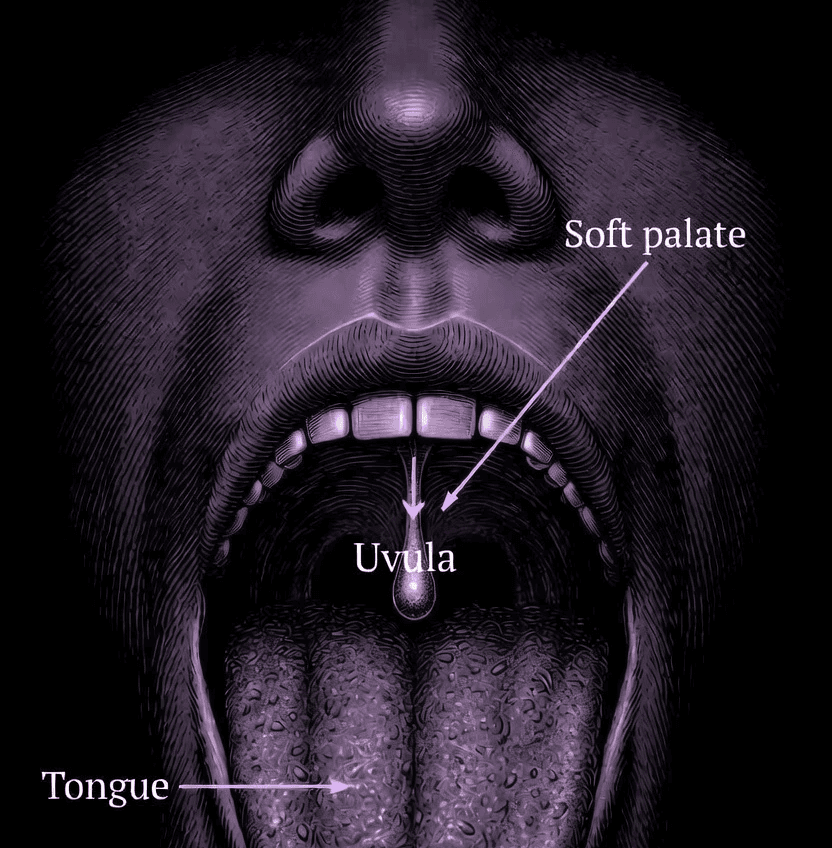
Snoring affects an estimated 90 million Americans, and for many of them, the culprit is hiding in plain sight — right at the back of the roof of the mouth. The soft palate, a small structure most people never think about, is responsible for a significant portion of all snoring. Understanding how and why it vibrates can help patients, caregivers, and physicians make better-informed treatment decisions.
What Is the Soft Palate, and Why Does It Vibrate?
The soft palate is a flexible, muscular structure located just behind the hard palate — the firm, bony roof of your mouth. It extends backward into the throat, ending at the uvula. During sleep, the muscles throughout the body relax — including the muscles that normally keep the soft palate taut and in position. When those muscles lose tone, the soft palate can sag into the airway. As air moves through the narrowed passage, it causes the soft, floppy tissue to vibrate rapidly against surrounding structures. That vibration produces the familiar rattling sound of snoring.
Palatal vs. Nasal vs. Tongue-Base Snoring
Snoring can originate from multiple sites — and identifying the primary source matters, because different locations respond to different treatments. Palatal snoring tends to produce a continuous, regular fluttering sound, often described as "classic" snoring. Nasal snoring often sounds more congested or stuffed-up, frequently associated with a deviated nasal septum or chronic allergic rhinitis. Tongue-base snoring tends to produce a deeper, more irregular sound, sometimes described as gasping or gurgling, and is often associated with obstructive sleep apnea.
The Role of Palatal Stiffness in Snoring Reduction
The key principle behind most palatal snoring treatments is simple: a stiffer palate vibrates less. When the soft palate has greater structural rigidity, it is less prone to the flapping motion that generates sound during airflow. Think of it like the difference between a taut bedsheet and a loose one hanging in a breeze — the loose sheet flaps loudly, while the tight one barely moves.
Historical and Established Approaches to Palatal Snoring
Over the past several decades, physicians have developed a range of techniques to address palatal snoring. Each comes with its own profile of efficacy, invasiveness, recovery time, and durability.
Uvulopalatopharyngoplasty (UPPP)
UPPP involves the removal of excess soft tissue in the throat — including parts of the soft palate, the uvula, and sometimes the tonsils. It is typically performed in a hospital under general anesthesia and carries a recovery period measured in weeks.
Laser-Assisted Uvulopalatoplasty (LAUP)
LAUP uses laser energy to reshape and scar the soft palate, reducing its tendency to vibrate. It is performed in an office setting under local anesthesia and typically requires multiple sessions.
Injection Snoreplasty
This office-based procedure involves injecting a sclerosing agent directly into the soft palate. The resulting inflammation and scar tissue stiffen the palate and reduce vibration.
The Pillar Procedure
The Pillar Procedure involved inserting three small braided polyester implants into the soft palate under local anesthesia in an outpatient setting. The implants stiffened the palate over time through the body's own fibrotic response. It was discontinued and is no longer commercially available in the U.S.
Radiofrequency Ablation (Somnoplasty)
Radiofrequency treatment applies controlled heat to the soft palate, causing subsurface tissue damage that results in fibrosis and stiffening over time. Multiple treatment sessions are often required.
Current Options and Their Trade-Offs
As of today, the landscape of palatal snoring treatments sits in a gap between aggressive surgical options and conservative approaches. For many patients with primary snoring or mild-to-moderate OSA who decline CPAP and surgery, access to minimally invasive palatal-specific options is limited.
The Future: Minimally Invasive Palatal Implant Approaches in Development
The unmet need in this space has attracted renewed research and development interest. Somnus Technologies, Inc. is developing HYPNARA™, a palatal implant designed for snoring and mild-to-moderate obstructive sleep apnea. HYPNARA™ is not yet FDA cleared and is not currently available for sale.
What to Discuss with Your ENT
If you suspect palatal snoring, an ENT specialist or sleep physician is your best starting point. Key questions to raise: Where is my snoring originating? Do I have obstructive sleep apnea? What palatal-specific options are appropriate for my anatomy? What are the trade-offs of surgical vs. non-surgical approaches? Snoring is far more than a nuisance — it can signal real airway physiology that deserves evaluation.
ABOUT THE AUTHOR
Matt Cronin
Founder & CEO, Somnus Technologies
Matt Cronin is a medical device operator with more than 20 years of experience in MedTech
commercialization, regulatory affairs, and product development. He is the founder and CEO of
Somnus Technologies, where he is leading the development of HYPNARA™ (a minimally invasive
palatal implant system) and MORPHEX™ AI (a smart oral device platform) for the treatment of
snoring and obstructive sleep apnea.
A U.S. Navy veteran and Lean Six Sigma Black Belt, Matt holds executive finance credentials from
Northwestern's Kellogg School of Management. He has personally invested in Somnus
Technologies and is committed to the mission of building ethical, effective, transparent MedTech
for patients who have been failed by existing options.
Contact: mcronin@somnustech.ai | somnustech.ai
Frequently Asked Questions
Q: Is soft palate snoring the same as sleep apnea? A: Not always, but they are related. Soft palate vibration causes snoring. When the soft palate fully collapses into the airway, it can cause obstructive sleep apnea (OSA) events — where breathing stops briefly. Snoring is often the audible warning sign that the airway is vulnerable to collapse. If you snore loudly and regularly, a sleep evaluation is worth pursuing.
Q: Can you fix soft palate snoring without surgery? A: Yes, for many patients. Options include mandibular advancement devices (oral appliances), positional therapy, weight loss if obesity is contributing, and minimally invasive palatal procedures. Major palate surgery (UPPP) is typically reserved for severe cases that don't respond to less invasive approaches.
Q: How do you know if your soft palate is causing your snoring? A: The gold standard is drug-induced sleep endoscopy (DISE) — a procedure where a physician uses a flexible scope to observe your airway under light sedation that mimics sleep. It reveals exactly where collapse is occurring. Snoring that is reduced or eliminated when sleeping on your side is also a strong indicator of palatal involvement.