Smart Mouthguards and Youth Sports
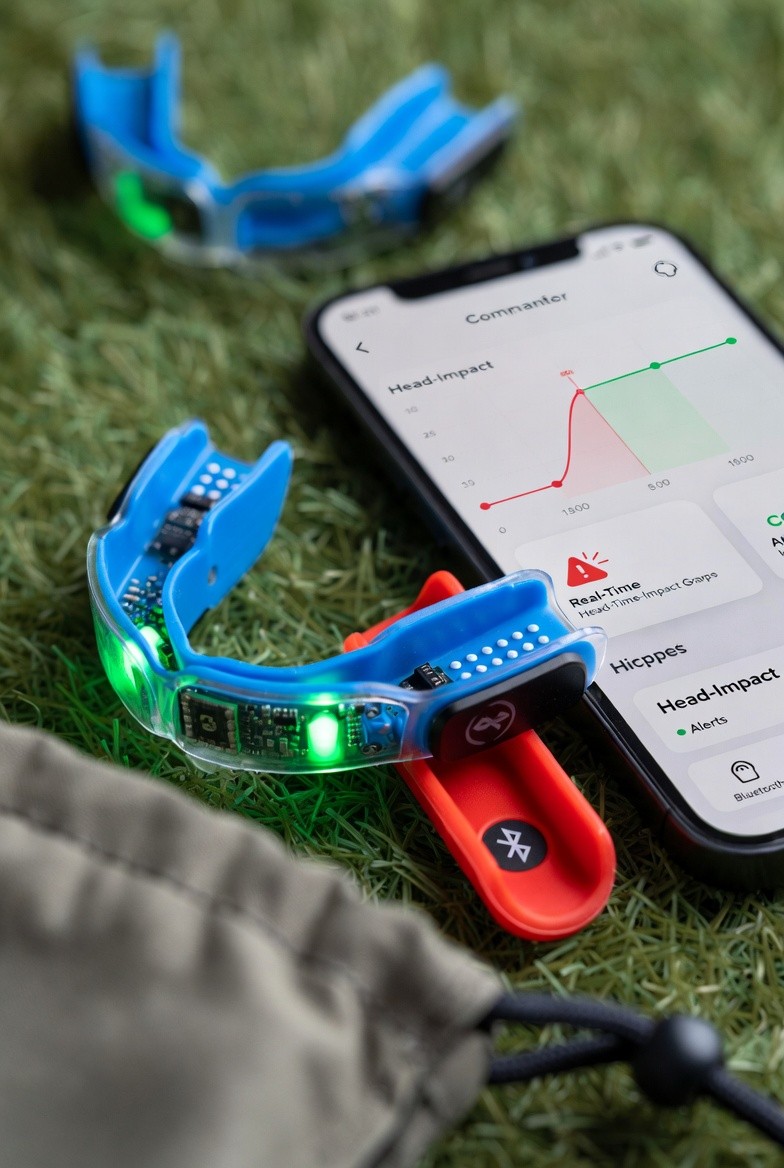
Every football Friday night, every soccer Saturday morning, millions of youth athletes strap on a mouthguard and step onto the field. For most of human history, that mouthguard served one purpose: protecting teeth. In the past decade, a new generation of smart mouthguards has expanded that role to include biomechanical data collection — tracking the force, direction, and frequency of head impacts in real time.
It is a genuine technological leap. But there is a dimension of athlete health that current smart mouthguards, for all their sophistication, are largely missing: the airway.
The Rise of Smart Mouthguards in Youth Sports
Smart mouthguards integrate miniaturized impact sensors — accelerometers and gyroscopes — with wireless data transmission capabilities to provide real-time monitoring of head acceleration events during athletic activity. World Rugby became the first governing body to integrate smart mouthguards into its official Head Injury Assessment protocol. The NFL has explored smart mouthguards for research purposes since 2019. At the youth level, a joint trial between SAHMRI and Adelaide University is combining smart mouthguard impact data with advanced brain MRI and cognitive testing to study how head impacts affect the developing brains of junior athletes aged 14 to 16.
What We Know About the Airway-Concussion Connection
Concussion, by definition, is a brain injury. But the brain does not function in isolation — it depends on consistent oxygen delivery, and oxygen delivery depends on the airway. After a concussion, the brainstem — which governs automatic breathing regulation — may lose its ability to correctly detect and respond to changes in carbon dioxide and oxygen levels in the blood. Concussed patients can develop shallow breathing, hyperventilation, and altered respiratory patterns driven by autonomic nervous system dysfunction. A case study published in Respirology Case Reports documented significant hypoventilation and progressive oxygen desaturation during exercise in a 17-year-old female athlete two years after a sports-related concussion.
The Gap: Impact Detection Without Airway Awareness
Current smart mouthguards are sophisticated impact sensors. They are very good at answering the question: Was this hit hard enough to warrant a concussion evaluation? What they cannot answer is an equally important question: How is this athlete's airway and breathing functioning right now? An intraoral device is, by its very nature, positioned at the gateway to the airway — adjacent to the palate, at the anatomical border between the oral cavity and the pharynx. From this position, it has potential access to physiological signals that no wristband or helmet sensor can capture with the same fidelity.
Why Continuous Airway Monitoring During Sports Matters
The case for airway monitoring in youth athletes extends beyond the post-concussion setting. During high-exertion activity, disruptions to breathing patterns affect performance and recovery. In the immediate post-impact window, an athlete's airway status may be as relevant as their cognitive status. During monitored return-to-play protocols, respiratory irregularities during exertion are one of the documented complications that can extend recovery timelines.
The Convergence of Intraoral Sensors, AI, and Airway Monitoring
The technical components required for intraoral airway monitoring already exist in various stages of development. Vibration sensors capable of detecting snoring and breathing patterns have been described in peer-reviewed literature. Intraoral photoplethysmography has been explored for oxygen saturation measurement. AI and machine learning algorithms can classify these signals in real time. What has not yet fully emerged is a purpose-built youth athletic platform that combines impact sensing with continuous intraoral airway monitoring.
What Coaches, Trainers, and Parents Should Know Today
The smart mouthguard market is evolving rapidly, and not all devices are equivalent. Current devices focus on impact, not airway — a smart mouthguard alerting system can help identify high-risk impacts, but it does not currently provide airway or breathing data. Breathing complaints after a concussion deserve clinical attention. An athlete who reports unusual shortness of breath or excessive fatigue during return-to-play protocols may be experiencing neurologically mediated respiratory dysregulation. Youth brains are uniquely vulnerable — technology standards in this space need to be built with pediatric physiology in mind.
Where the Technology Is Heading
The next generation of smart intraoral devices is likely to be multifunctional — combining impact sensing with continuous physiological monitoring in a single wearable platform. One company developing in this space is Somnus Technologies, Inc., a Wisconsin-based medical device company building the MORPHEX™ AI platform. Somnus Technologies is exploring AI-driven intraoral monitoring with applications that extend beyond sleep medicine — including airway and physiological monitoring in active settings. MORPHEX™ AI is not FDA cleared and is not currently available for sale.
For coaches, athletic trainers, and parents, the message is straightforward: the current generation of smart mouthguards represents a meaningful advance in youth sports safety. But the technology has not yet fully realized its potential. As the next generation of intraoral devices develops, those closest to youth athletes should stay informed — and ask more from the technology designed to protect the athletes in their care.
ABOUT THE AUTHOR
Matt Cronin
Founder & CEO, Somnus Technologies
Matt Cronin is a medical device operator with more than 20 years of experience in MedTech
commercialization, regulatory affairs, and product development. He is the founder and CEO of
Somnus Technologies, where he is leading the development of HYPNARA™ (a minimally invasive
palatal implant system) and MORPHEX™ AI (a smart oral device platform) for the treatment of
snoring and obstructive sleep apnea.
A U.S. Navy veteran and Lean Six Sigma Black Belt, Matt holds executive finance credentials from
Northwestern's Kellogg School of Management. He has personally invested in Somnus
Technologies and is committed to the mission of building ethical, effective, transparent MedTech
for patients who have been failed by existing options.
Contact: mcronin@somnustech.ai | somnustech.ai