Sleep Apnea
The Oral Appliance Has Been Lying to Your Clinician for Decades No compliance data. No feedback loop.
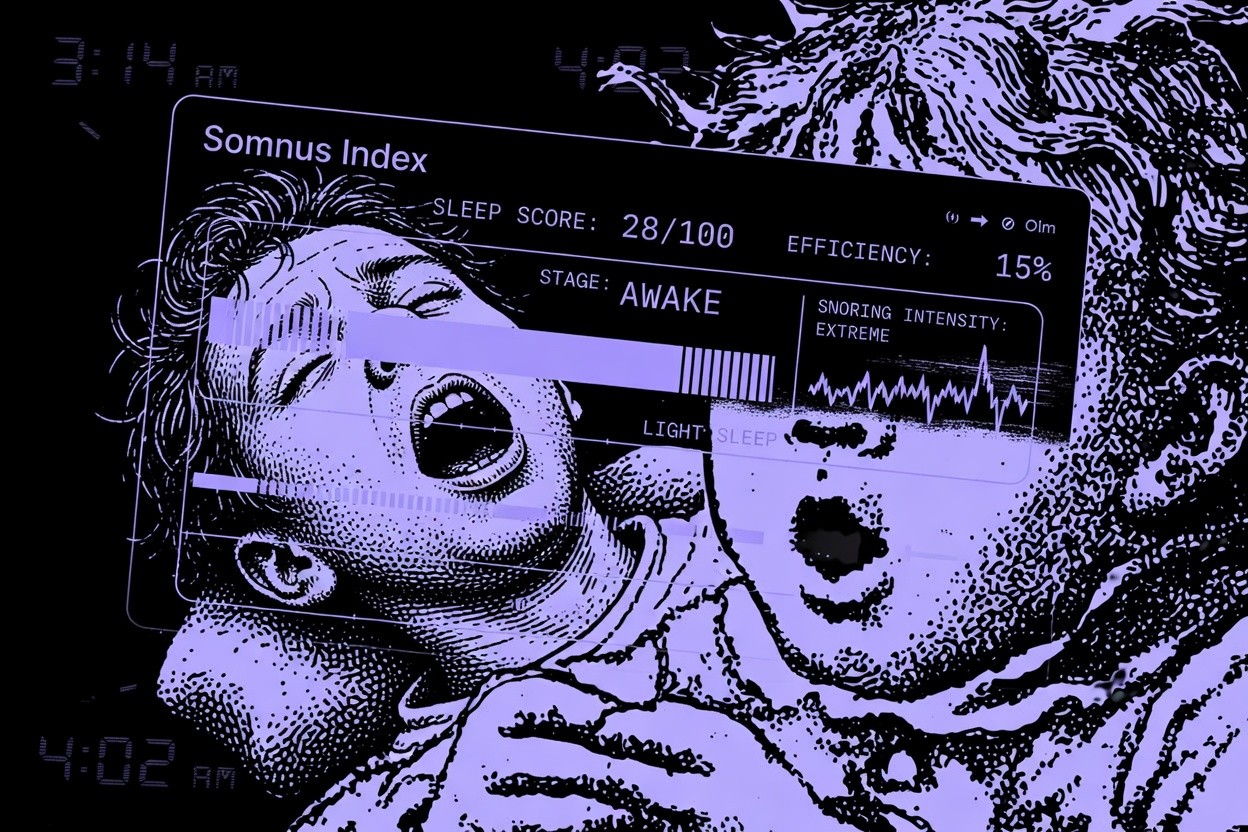
Millions of people wear oral appliances for sleep apnea every night. Their clinician has no idea what happened while they slept. That needs to change.
That sentence has been sitting in my chest for a long time. Not as a complaint. As a starting point.
I'm building a medical device company focused on obstructive sleep apnea. 83.7 million U.S. adults have it. Millions of them have tried CPAP, quit within the first year, and gone back to suffering. Some land on oral appliance therapy — a mandibular advancement device, worn every night to keep the airway open. For many patients it's a reasonable option. The compliance is better than CPAP. No machine, no mask, nothing to plug in.
There's also no data.
Not a single byte.
The Problem Nobody Talks About Loudly Enough
Traditional oral appliances are passive mechanical tools. They hold the jaw forward. That's it. They cannot tell a clinician how long they were worn. They cannot tell you whether an apnea event was stopped or ignored. They provide no feedback loop for titration, no outcome tracking, no signal that treatment is failing — until the patient quietly gives up and stops using the device entirely.
Sound familiar? It should. That's the same dynamic that kills CPAP adherence. And 30 to 50 percent of CPAP patients discontinue within the first year. Oral appliances aren't immune to the same arc. The device stops working, or the patient stops believing in it, and nobody catches it in time.
Here's what I find remarkable: the sleep medicine community has accepted this for decades. Not because they don't care. Because there was nothing better.
That is changing.
What "Smart" Actually Means
The word gets used loosely. In this context it has a specific and meaningful definition.
A truly smart oral device contains miniaturized sensors physically embedded in the appliance shell. Accelerometers to detect jaw movement and head position. Photoplethysmography sensors to measure blood oxygen saturation and pulse rate. Vibration sensors to detect snoring and airway events. Temperature sensors to confirm the device is actually being worn — not sitting on the nightstand.
Raw sensor data requires interpretation. AI and machine learning algorithms — running either on an embedded microprocessor or in a connected application — analyze those signals and distinguish between clinically relevant events and noise. That's where the intelligence lives.
The data transmits wirelessly to a companion app. Patient-facing dashboards translate complex physiological signals into something actionable — sleep quality scores, snore frequency trends, estimated AHI proxies, wearing time. Clinician-facing portals give providers the data they need to titrate more precisely and monitor outcomes remotely.
And here's what most people miss: the oral cavity is a better sensor platform than the wrist. An intraoral device sits directly adjacent to the upper airway. Direct mechanical coupling to the jaw, the palate, the pharyngeal walls. No smartwatch gets you that.
Why It Matters — Three Pillars
The clinical case is straightforward once you see it.
Objective compliance data replaces self-report. Clinicians finally get accurate information about actual device use — not what patients remember or estimate. What actually happened.
Real-time physiological feedback enables more precise titration. Instead of adjusting blind in a dental office and waiting weeks to see if it helped, clinicians make data-informed decisions.
Continuous outcome monitoring allows early detection of treatment failure — before the patient quietly stops wearing the device and goes back to suffering. That's the intervention point that's been missing for decades.
The Build
This weekend — while mom was away for college visits — me and the boys were heads down working on exactly this problem. Quiet weekend. Real work. The kind that doesn't make the highlight reel but moves the needle.
I'm deep in this space. I'm building in it. And I'll be writing about it here — the technology, the regulatory reality, the clinical gaps, and what it actually takes to bring something like this to market.
If you're a clinician who wants to follow where this is heading, reach out at somnustech.ai.
What I'd Tell Patients and Clinicians Today
If you're wearing an oral appliance right now, ask your clinician three questions: Does this device record how long I actually wore it? Can you see my usage and outcome data remotely? Has this been validated in a real sleep study population?
If the answer to any of those is no — you're being managed blind.
If you're a clinician, the question is simpler: do you want to manage oral appliance therapy with the same data-driven rigor you've applied to CPAP for years — or keep adjusting without a signal?
The technology is here. The gap is real. The build continues.
If something resonated — or if you think I've gotten something wrong — reply. This is a conversation, not a broadcast. Next piece we go deeper on what it actually takes to embed meaningful intelligence into a device people wear in their mouth every night.
ABOUT THE AUTHOR
Matt Cronin
Founder & CEO, Somnus Technologies
Matt Cronin is a medical device operator with more than 20 years of experience in MedTech
commercialization, regulatory affairs, and product development. He is the founder and CEO of
Somnus Technologies, where he is leading the development of HYPNARA™ (a minimally invasive
palatal implant system) and MORPHEX™ AI (a smart oral device platform) for the treatment of
snoring and obstructive sleep apnea.
A U.S. Navy veteran and Lean Six Sigma Black Belt, Matt holds executive finance credentials from
Northwestern's Kellogg School of Management. He has personally invested in Somnus
Technologies and is committed to the mission of building ethical, effective, transparent MedTech
for patients who have been failed by existing options.
Contact: mcronin@somnustech.ai | somnustech.ai